


4/10/25
We have been processing all of the changes in the NJSIAA group and sectional realignments over this past few weeks. Looking at both documents from the classification previously to the new, there are several significant changes in how schools are classified which we detail below. We also will take a look at 2 other scenarios… first, if the groups were kept at equal size and second, if we added a fifth group to the mix. We evaluate the positives and negatives with each scenario.
Group IV Changes for 2025
Southern Regional: One of the most impactful changes is Southern Regional (enrollment 1,425 in 2022-2024) moving from Group IV South to Group III South for 2024-2026. This is a major benefit for Southern Regional, which has been a volleyball powerhouse. They’ll no longer have to compete against larger schools like Hunterdon Central (2,466 students) and Old Bridge (2,021 students) for championships.
Westfield High School: They’re moving up from Group III North (enrollment 1,398) to Group IV North (enrollment 1,304), despite having fewer students. This is likely due to the shifting enrollment boundaries between groups.
Group III Changes
Howell High School: Moving from Group IV South (enrollment 1,476) to Group III South (enrollment 1,393). This is originally perceived as an advantage for Howell but could be a disadvantage as they still are in the same group as Southern Regional.
Absegami High School: Moving from Group II South (enrollment 893) to Group III South (enrollment 843), despite having fewer students.
Group II Changes
Mainland Regional High School: Moving from Group II South (enrollment 905) to Group III South (enrollment 868), placing them in a more competitive group.
North Plainfield High School: Moving from Group II South (enrollment 861) to Group III North (enrollment 872). This geographical shift could significantly change their competitive landscape.
University High School: This developing program has been combined with Malcolm X Shabazz in a co-op, now in Group III North.
Group I Changes
The most dramatic change is that Group I has expanded significantly in the 2024-2026 classification, with many more schools in both North and South sections.
Enrollment Range Analysis
The enrollment ranges for each group have shifted significantly:

This shows a significant widening of the Group IV range, particularly in the North section, and smaller adjustments to the other groups.
Winners and Losers of the Realignment
Winners
- Southern Regional: Moving from Group IV to Group III is a major competitive advantage for this powerhouse program.
- Union City High School: Remains in Group IV North with one of the largest enrollments (2,782), giving them a size advantage over many competitors.
- Elizabeth High School: With by far the largest enrollment (5,409) in Group IV North, they maintain a significant size advantage.
- Schools moving down a group: Teams like Howell High School that move from Group IV to Group III may face less intense competition.
- Private schools in smaller groups: Schools like Don Bosco Prep, Christian Brothers Academy, and Bergen Catholic often have strong volleyball programs and can benefit from being in smaller groups despite having selective admission processes.
Losers
- Teams remaining in Group IV South: With Southern Regional moving down, the competitive landscape changes, but they still face tough competition from schools like Old Bridge.
- Schools moving up a group: Teams like Absegami and Mainland Regional that moved from Group II to Group III will face tougher competition.
- Teams in groups with powerhouse programs: Any Group III South team will now have to contend with Southern Regional.
- Schools with enrollment at the bottom of their group range: These schools compete against much larger student populations, creating a potential disadvantage.
- Westfield High School: Their move from Group III to Group IV despite having fewer students places them against larger schools.
Geographical Impact
There’s also a geographical component to these changes. Some schools have moved from North to South sections or vice versa, which can significantly change travel requirements and traditional rivalries.
Anomalies in Group Sizes
The group sizes are imbalanced:
- Group IV has fewer schools than might be expected
- Group III appears relatively balanced
- Group II is slightly smaller
- Group I has become the largest group in terms of number of schools
This could lead to:
- More competitive tournaments in Group I with more teams participating
- Potentially easier paths to championships in Group IV with fewer competitors
- Disproportionate representation in state tournament
Current Situation (2024-2026)
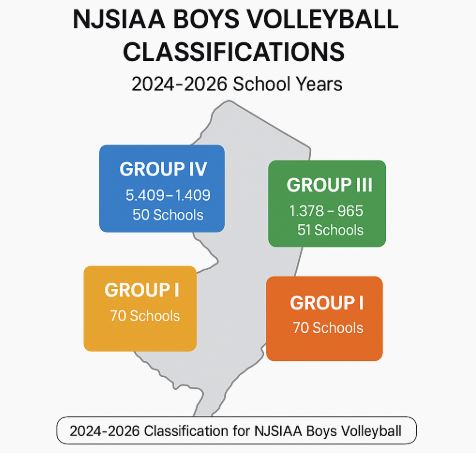
Here’s the current distribution of schools for 2024-2026:
- Group IV North: 25 schools
- Group IV South: 25 schools
- Group III North: 26 schools
- Group III South: 25 schools
- Group II North: 24 schools
- Group II South: 24 schools
- Group I North: 34 schools
- Group I South: 36 schools
Total: 219 schools
Conclusion
The 2024-2026 realignment creates significant changes in the competitive landscape of New Jersey boys volleyball. Southern Regional’s move to Group III is perhaps the most consequential change, giving them an easier path to a group championship. Schools that moved up a group classification generally face a more difficult competitive environment, while those moving down may benefit.
The imbalance in group sizes also raises questions about tournament structures and the fairness of the classification system, particularly with Group I having the most schools despite representing the smallest enrollment range.
NJSIAA Boys Volleyball Classification – Equal Group Distribution Hypothesis
Equal Proportioning Analysis
Hypothetically, if we divided these 219 schools equally across the four groups, each group would have approximately 55 schools (about 27-28 schools per North/South section).
Impact on Classification Boundaries
To create equal groups, the enrollment boundaries would significantly shift:
- Group IV: Would include only the top 55 schools by enrollment (roughly schools with 1,200+ students)
- Group III: Would include the next 55 schools (roughly schools with 800-1,200 students)
- Group II: Would include the next 55 schools (roughly schools with 500-800 students)
- Group I: Would include the remaining 54 schools (schools with under 500 students)
Major Changes If Implemented
- Group IV would shrink:
- Current Group IV cutoff is as low as 1,409 in North and 1,395 in South
- New cutoff would be around 1,200 students
- Many current Group IV schools would move to Group III
- Group III would substantially change:
- Current Group III range is 1,378-985 (North) and 1,393-959 (South)
- New range would be approximately 1,200-800
- Several schools would move up from Group II, while others would move down to Group III
- Group II would expand upward:
- Current Group II range is 956-673 (North) and 949-670 (South)
- New range would be approximately 800-500
- Many Group I schools would move up to Group II
- Group I would be more clearly defined:
- Current Group I has a very wide range (664-78 in North, 667-124 in South)
- New Group I would only include schools with fewer than approximately 500 students
- This would create a more level playing field in Group I
Specific School Impacts
- Schools that would benefit:
- Schools at the low end of their current group (e.g., Barringer HS with 1,811 students at the bottom of current Group IV North)
- These schools would move down a group and face schools with similar enrollment
- Schools that would be disadvantaged:
- Schools at the top of their current group (e.g., Teaneck HS with 956 students at the top of Group II North)
- These schools would move up a group and face larger schools
- Key movements:
- Many current Group IV schools with enrollments between 1,100-1,400 would move to Group III
- Several current Group I schools with enrollments over 500 would move to Group II
- Group III would become much more competitive with more evenly matched schools
Competitive Balance Impact
- More equitable competition:
- Schools would compete against others with more similar enrollments
- The very wide enrollment ranges in the current system (e.g., Group IV North ranges from 5,409 to 1,409 students) would be narrowed
- Disruption to traditional rivalries:
- Schools that have historically competed against each other might be separated
- New rivalries would need to develop
- Tournament structure:
- No group would have significantly more or fewer teams than others
- State tournaments would have more balanced brackets
Practical Considerations
While equal proportioning seems logical, the NJSIAA likely considers other factors:
- Geographic distribution: Ensuring enough schools in each region to create viable tournaments
- Program history: Some schools may have historically competed in certain groups
- Program strength: Some adjustments may be made based on program strength rather than just enrollment
- Balance between public and non-public schools
Conclusion
Equal proportioning would create a more mathematically balanced classification system with more evenly matched competitions. However, it would represent a significant disruption to the current structure and would result in many schools changing their competitive landscape.
The most dramatic changes would be seen in Group I (which would shrink considerably) and in the boundaries between Groups III and IV, where many schools would shift downward. This would particularly benefit schools currently at the bottom of Group IV who would move to Group III and face more similarly-sized competitors.
Equal Distribution Methodology
- Schools were divided into North and South sections based on their geographic location (using northing numbers)
- Within each section, schools were sorted by enrollment (highest to lowest)
- Each section was then divided into 4 equal-sized groups
Based on the 2024-2026 classification data, here’s how the groups would look if they were equally distributed by enrollment.
North Section Classifications

Group IV North Range: 5,409 - 1,315

Group III North Range: 1,316 - 893

Group II North Range: 928 - 288

Group I North Range: 634 - 78

Group IV South Range: 2,100 - 1,333

Group III South Range: 1,370 - 843

Group II South Range: 959 - 536

Group I South Range: 645 - 124
Impact of Equal Distribution
Key Changes from Current Classification:
- Group IV becomes more exclusive:
- North: Minimum enrollment increases from 1,409 to 1,315
- South: Minimum enrollment increases from 1,395 to 1,333
- Group III becomes more balanced:
- North: Range narrows to 1,316 – 893
- South: Range shifts to 1,370 – 843
- Group II expands downward:
- North: Range becomes 928 – 288
- South: Range becomes 959 – 536
- Group I becomes more clearly defined:
- Contains only the smallest schools (generally under ~650 students)
- Creates more equitable competition between similarly sized programs
This equal distribution would create more balanced competition within each group while maintaining the North/South sectional structure.
NJSIAA Boys Volleyball Classification – Five Equal Groups Hypothesis
This analysis shows how the NJSIAA Boys Volleyball classifications would look if distributed into five equal groups instead of the current four-group system.
Equal Distribution Methodology
- Schools were divided into North and South sections based on geographic location (using northing numbers)
- Within each section, schools were sorted by enrollment (highest to lowest)
- Each section was then divided into 5 equal-sized groups (instead of 4)
North Section Classifications (5 Groups)
Group V North (Largest 22-23 Schools)

Group V North Range: 5,409 - 1,462
Group IV North (Next 22-23 Schools)

Group IV North Range: 1,424 - 1,056

Group III North Range: 1,042 - 786

Group II North Range: 842 - 377

Group I North Range: 521 - 78
South Section Classifications (5 Groups)

Group V South Range: 2,100 - 1,405
Group IV South (Next 21-22 Schools)

Group IV South Range: 1,435 - 964
Group III South (Next 21-22 Schools)

Group III South Range: 1,188 - 722
Group II South (Next 21-22 Schools)

Group II South Range: 764 - 417
Group I South (Remaining Schools)

Group I South Range: 511 - 124
Impact of Adding a Fifth Group
Enrollment Range Analysis (Current vs. Five Groups)

Key Effects of a Five-Group System
- Narrower Enrollment Ranges:
- Each group would have a smaller gap between the largest and smallest schools
- More equitable competition as schools face opponents of more similar size
- Tournament Structure:
- Five champions instead of four
- Potentially more opportunities for smaller schools to win championships
- More balanced tournament brackets with fewer schools per group
- Group Terminology Changes:
- Current Group IV would become Group V
- All other groups would shift up one number
- Smallest schools would remain in Group I
Winners and Losers in a Five-Group System
Winners
- Mid-sized Schools:
- Schools currently at the bottom of Group III or top of Group II would have more balanced competition
- Examples: Colonia HS (1,042), Orange HS (1,022), Hammonton HS (1,023)
- Small-Medium Schools:
- The creation of an additional middle group (new Group III) would create more balanced competition
- Examples: North Plainfield HS (872), Wayne Hills HS (874)
- Traditional Powers in Lower Groups:
- Powers like Southern Regional would dominate in Group IV instead of competing against the largest schools
Losers
- Schools at Group Boundaries:
- Some schools would face tougher competition by moving up a group
- Example: Lenape HS would move from middle of Group IV to top of new Group IV
- Administrative Complexity:
- NJSIAA would have to manage an additional group in tournaments
- More playoff games and scheduling complexity
- Traditional Rivalries:
- Some traditional rivals might be split into different groups
Competitive Balance Improvement
A five-group system would significantly improve competitive balance, particularly for:
- Current Group I Schools:
- The smallest schools would only compete against truly similar-sized institutions
- Enrollment gap in Group I would shrink from 586 students (664-78) to 443 students (521-78) in North
- Current Group IV Schools:
- The massive enrollment gap in Group IV North would be reduced from 4,000 students (5,409-1,409) to 3,947 students (5,409-1,462) but with fewer schools in the group
- Middle-Tier Schools:
- The creation of a new middle tier would provide a clear placement for schools that are currently at the boundaries between groups
Well that was a lot of information. It’s not really feasible to think some of the alternate ideas will be implemented in the future but is fun to look outside the box and keep ideas flowing on how our student athletes can have the best and fairest experience at high school athletics. What do you think? Feel free to share comments on this post or email us at njpowerranking@gmail.com,